

DMCC Approved Auditors in Dubai
All companies registered with DMCC free zone must maintain proper accounting records, appoint one of the DMCC approved auditors, and submit audited financial statements within 6 months of the financial year-end to avoid fines and ensure compliance. Vertix Auditing is one of the approved DMCC approved audit firms providing statutory external audit, internal audit, tax compliance, and corporate advisory services.
KEY POINTS
- All companies operating in DMCC free zone must conduct their annual audits through one of the DMCC approved auditors.
- Audited financial statements must be in compliance with IFRS standards and submitted to the DMCC authority within 6 months after the financial year end. Failure to do so may result in fines, penalties, or license suspension.
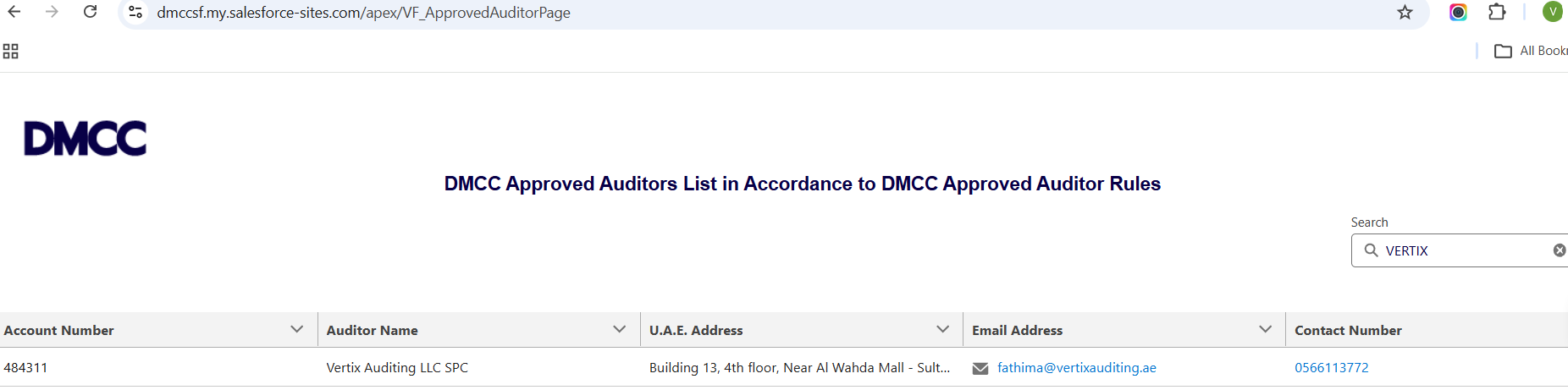
- Companies must appoint an auditor from the official list of approved DMCC auditors to maintain compliance with DMCC regulations. The image below confirms Vertix Auditing’s inclusion among the DMCC approved audit firms.
Dubai is home to a large number of free zones, which are a source of attraction to international investors and one of the most notable is the Dubai Multi Commodities Centre (DMCC). The authority requires organizations registered in this free zone to adhere to financial reporting and audit standards. The means all the registered businesses should appoint one of the DMCC approved auditors who will examine their financial statements to ensure they comply with the accounting standards and applicable regulations of DMCC.
Selecting an appropriate auditing firm can assist companies to complete their audits in a timely manner, have an independent assessment of how their business is performing, review of internal control system, and strengthen financial discipline of the company. So, the audit is not only to comply with DMCC requirements, but to benefit your organization through a transparent financial review.
Dubai Multi Commodities Centre (DMCC) at a Glance
The Dubai Multi Commodities Centre (DMCC) is a leading international free zone and business hub in Dubai. DMCC was established in 2002 to make Dubai one of the best international gateways for commodity trading and enterprise development.
DMCC has expanded considerably over the years and hosts over 26,000 companies from more than 180 countries. These firms are involved in different sectors, such as commodities trading, technology, financial services, consulting, logistics and manufacturing.
DMCC plays a significant role in the economy of Dubai and contributes significantly to foreign direct investment in the emirate.
The free zone provides a dynamic business environment and world-class infrastructure. It consists of two significant developments:
- Jumeirah Lakes Towers (JLT)
- Uptown Dubai
These places accommodate 100,000 residents, visitors, and professionals who work and live within the community. DMCC is also an internationally recognized free zone that has been rated among the best free zones in the world. It has received the award of a “Global Free Zone of the Year” several times due to its robust business environment and investor-friendly policies.
Key Highlights of DMCC
- Business-friendly tax environment
- 0 percent tax on personal income
- Prime location, modern infrastructure and transportation access
- Flexible office solutions for businesses of all sizes
- 100 percent foreign ownership of companies, meaning you don’t need to involve an Emirati local partner
- Unrestricted repatriation of profits
- Digital services via DMCC Member Portal (DMCC uses all the possibly technologies in its disposal)
- Vibrant community with thousands of residents and professionals
- Networking opportunities with over 26,000 growing firms
- Simple, easy, and cost effective company setup in DMCC
For a complete overview of DMCC Free Zone, including DMCC company formation, licensing costs, benefits, business activities, setup process, visa requirements, office options, and compliance requirements, see our detailed DMCC Free Zone Guide.
Types of Business Licenses in Dubai Multi Commodities Centre (DMCC)
Businesses operating in DMCC are required to obtain an appropriate license according to their activities. The different types of licenses available in the free zone are:
- Trading License: A trading license enables companies to import, export, distribute and store goods in the UAE and internationally.
- Service License: This license is issued to those companies offering professional or consultancy services like marketing, IT consulting, legal consulting, or financial advisory.
- Industrial License: Industrial licenses are granted to companies that deal with manufacturing or processing activities in designated areas.
- E-Commerce License: This license has been launched for the businesses that deal with online trading and digital commerce activities.
- Crypto and Proprietary Trading License: DMCC has also introduced specialized licenses for companies involved in digital asset and crypto-related activities in its regulatory framework.
Each license category can have different regulatory and reporting requirements, including compliance with DMCC audit requirements.
Corporate Tax and Cryptocurrency in Dubai Multi Commodities Centre (DMCC)
Corporate Tax in DMCC
With the introduction of the UAE Corporate Tax in 2023, companies operating in free zones, such as DMCC, must follow the tax regime developed by the Federal Tax Authority. DMCC registered entities are eligible to enjoy a 0 percent corporate tax rate on qualifying income if they meet the criteria of a Qualifying Free Zone Person (QFZP) and comply with all the regulatory provisions. However, companies with non-qualifying income will be charged with the normal UAE corporate tax rate of 9 percent. If your company fulfills the QFZP and qualifying income requirements, the audit becomes mandatory for UAE corporate tax filing as well.
Cryptocurrency in DMCC
The Dubai Multi Commodities Centre has made a major contribution to the development of the digital asset sector in the UAE. In May 2021, the authority issued its first license related to crypto assets, which allows companies to conduct over-the-counter transactions of digital currencies. Since then, DMCC has continued to develop and grow its digital finance ecosystem through initiatives such as the DMCC Crypto Centre, which supports block chain innovators, fintech businesses and companies working with virtual assets.
Organizations operating in this sector are still required to adhere to the financial reporting standards and must have their financial statements reviewed by approved auditors in DMCC in order to remain compliant with regulatory requirements.
Also Read: How Do Different Countries Tax Cryptocurrencies
Requirement for Annual Audit by DMCC Approved Auditors
An external audit for all the DMCC companies is mandatory as per Section 11, Article 57 of the DMCC Companies Limited by Guarantee Regulations. But what are the requirements of an annual audit for DMCC companies? Entities registered with DMCC must maintain adequate financial records and prepare year-end financial statements for audit in accordance with the applicable accounting standards. The specific requirements in relation to accounts, auditing, and financial management are as follows:
Preparation of Accounts
1) Accuracy of financial accounting plays the fundamental role in ensuring reliability of a company’s financial records. The directors of every company are required to prepare yearly financial statements. These financial statements should:
- Be prepared in accordance with International Financial Reporting Standards (IFRS), and International Accounting Standards (IASs)
- Give a fair and accurate picture of the financial position and performance of the company
- Be approved and signed by at least one of the authorized directors on behalf of the shareholders (if more than one shareholders)
2) In case of a holding entity, you must prepare group financial statements as well as individual company accounts.
3) Dormant companies do not need to prepare financial statements unless the shareholders who represent at least 10 percent of the organization’s membership request the management to prepare the accounts. However, they must give notice for the same within 1 month after the end of the financial year.
4) Companies must ensure that their accounts are prepared in line with IFRS/IAS within 6 months of the financial year end, and are:
- Ready and approved by Directors
- Reviewed by DMCC registered auditors
- Presented to shareholders in the annual general meeting
Following the approval of accounts, the entity is obliged to submit their audited financial statements and report of the auditor with the DMCC Registrar within five business days of the meeting.
Maintenance of Accounts
1) Companies registered under DMCC must maintain adequate accounting records that describe the business transactions and financial activities in detail.
These records must:
- Show the financial position of the business accurately
- Allow Directors of the company to ensure that the financial statements are in line with the applicable regulations, specifically section 11 of the Article 57 of the DMCC Companies Limited by Guarantee Regulations
2) Accounting records of the Entity must be:
- Stored at the registered office of the company or otherwise any other place that is approved by the Directors and suitable for security of business data
- Available for review or inspection by company’s auditor or by an officer of the DMCC
- Tax-related records must be kept for at least five years
- Real estate-related accounting records must be stored for at least fifteen years.
3) Company members have the right to demand the latest audited financial statements and the auditor’s report. If requested, this should be made available to them within a period of five business days.
DMCC Audit Submission Deadline
DMCC companies must submit their annual audited accounts within six months of their financial year end. The authority can extend the deadline depending on your circumstances. To ensure audit is completed well before the submission deadline, companies should maintain proper books of account, retain all supporting documentation, prepare audit schedules in advance, and appoint a DMCC approved audit firm immediately after the year-end.
Penalties for Non-compliance with DMCC Audit Regulations
What are the penalties of non-compliance with audit deadlines in the Dubai Multi Commodities Centre (DMCC)? Some of the potential consequences are:
- Financial or administrative fines
- Temporary discontinuation of some services of the firm
- Delay in renewal of trade license
- Restrictions on operations of the company until full compliance is achieved
Therefore, businesses should always engage with audit firms in DMCC that are certified by the authority to ensure timely completion and submissions of audits.
Process of Audit in Dubai Multi Commodities Centre (DMCC)
The audit process in DMCC is more or less same as any other audit. Below is the step-by-step process of audit in DMCC.
- The company appoints one of the auditors authorized by Dubai Multi Commodities Centre.
- The DMCC auditor reviews the financial statements and verifies business transactions against supporting documents. The auditor also verifies that the company is not operating without a valid trade license.
- The auditor prepares the audit report in line with the International Financial Reporting Standards (IFRS).
- The audit firm issues the audited financial statements along with their audit opinion. This company then submits this report to DMCC.
- DMCC representatives review the audit report. In case they have any questions or clarifications, they contact the appointed audit firm for the same.
- If DMCC concludes that the auditor has not performed the audit with utmost responsibility, due care, transparency, and in accordance with International Accounting Standards, DMCC can penalize the audit firm and remove the firm from the official DMCC approved auditors list.
What Documents Are Required for a DMCC Audit?
- Company’s trial balance
- Profit & loss, balance sheet, and other financial reports generated from the accounting system, such as general ledger, aged receivables and payables report.
- Invoices, bills, journal vouchers, sales and purchase returns and credit card statements for the sample transactions selected by DMCC auditors
- All the bank statements and bank reconciliation reports of your company (local and international banks) applicable to the audit period
- Reconciliation of Value Added Tax filing and UAE corporate tax filing (for non-qualifying income) with the books of accounts.
- Schedule of fixed assets and prepayments
- Inventory records (if applicable)
- Bank financing documents and loan agreements
- Verify the gratuity calculation to ensure the company correctly calculates and records the year-end provision for UAE end-of-service benefits in the accounts
- Previous year’s audited financial statements
- Updated trade license of the Entity
- Certificate of registration (if applicable)
- Share certificate
- Memorandum of Association (MoA) / Articles of Association (AoA)
- Passport copy, Emirates ID, and Visas of shareholders of the company to perform KYC
Roles and Responsibilities of Audit Firms in DMCC
DMCC auditors review the financial documents of the company and ensure that they are in compliance with the regulatory requirements
Some of the roles and responsibilities of auditors include the following:
- Ensure that the company has maintained proper and adequate accounting records
- Verify that all the business transactions have supporting documents
- Prepare the accounts according to IFRS/IAS standards
- Ensure that the company is operating as per the activities permitted under its trade license
- Verify that the company does not overstate or understate its income and expenses
- Verify that the company does not overstate or understate its assets and liabilities
- Ensure that the entity does not engage in money-laundering or fraudulent activities
Auditors can also access company records and demand more information from management whenever required. If the auditor concludes that the company has failed to comply with the regulations, the auditor should clearly disclose this in the audit report.
Our Audit Services Across the UAE
While Dubai Multi Commodities Centre is one the leading free zones of the UAE, businesses in majority of other free zones, key business hubs, and mainland jurisdictions like DET, ADDED etc. require audit services for shareholders, investors, banks, and regulatory compliance. Vertix auditing is providing audit and assurance services to companies in all these jurisdictions and business hubs across the UAE. Below are some of the many free zones and mainland areas we cover:
Dubai
Dubai is one of our key service locations with majority of our clients operating from this Emirate. We serve real estate brokers, project consultants, holiday home companies, HR consultants, marketing companies, trading companies, healthcare, and hospitality companies.
Abu Dhabi
We serve a large number of clients in Abu Dhabi for audit, tax, transfer pricing, and accounting services. Our firm is one of the top ten audit firms in Abu Dhabi and delivers quality, reliability, and timely service. We serve multiple F&B groups, family offices, asset managers, and holding companies.
Sharjah
Sharjah is another key location we serve on a regular basis. We are an approved audit firm in Sharjah for audit and assurance services. Our clients include real estate companies, business consultants, trading companies, training institutes, engineering consultants, among many others.
Dubai Silicon Oasis (DSO)
DSO is one of the leading free zones in the UAE with over 5,000 registered businesses. We are one of the approved auditors in DSO for external audit and related assurance services.
Meydan Free Zone
Businesses know Meydan free zone for its easy company registration, visa issuance, and affordability. All businesses registered in Meydan must have their annual accounts audited by an approved audit firm. As one of the Meydan approved auditors, Vertix provides quality and competitive audit services to a large number of Meydan businesses.
International Free Zone (IFZA)
International Free Zone Authority (also known as IFZA) is one of the most competitive free zones in Dubai. A large number of startups, SMEs, freelancers, small business consultants, and entrepreneurs currently operate under IFZA. All the IFZA registered businesses must appoint an IFZA approved auditor (like Vertix Auditing) to audit their annual financial statements.
Dubai World Central (DWC)
Companies registered in Dubai World Central require annual audit services to comply with free zone audit requirements and make informed business decisions. Vertix provides statutory audits and other support services as a DWC approved audit firm . We regularly provide audit, tax, M&A, and advisory services to a number of DWC registered companies.
Dubai Airport Free Zone (DAFZA)
DAFZA is a prestigious free zone located nearby Dubai International Airport. DAFZA houses more than 3,300 businesses across more than 20 sectors. Annual audit is mandatory on all the registered companies in DAFZA. We provide audit and assurance services to companies operating in this free zone, including trading companies, service businesses, freelancers, business consultants, etc.
Jebel Ali Free Zone (JAFZA)
Many consider JAFZA the largest customs-bonded area in the Middle East. It houses a staggering 11,000+ businesses and considered to be one of the largest economic zones in the UAE. We serve a growing number of clients operating from JAFZA free zone. Every JAFZA registered company must get its accounting records audited by an approved audit firm. Vertix Auditing is one of the JAFZA-approved auditors, serving a growing portfolio of clients each year with audit, tax, and advisory services.
Why Vertix Auditing?
As a DMCC approved auditor and licensed UAE audit firm, Vertix provides audit and assurance services to a wide range of companies registered in different free zones and mainland areas of the UAE. Our team includes qualified Chartered Accountants (ICAEW), CPAs, and ACCA professionals with extensive experience auditing UAE businesses. We have in-depth knowledge of and experience with DMCC’s specific audit and financial reporting requirements. Our experts also understand the relevant submission deadlines and administrative penalties for non-compliance. Therefore, we help businesses fulfill their audit and reporting requirements on time while ensuring compliance with other applicable rules and regulations of DMCC. Contact us today for a competitive DMCC audit quote or a free, no-obligation audit consultation.
Frequently Asked Questions (FAQs)
1 – How to find auditors authorized by DMCC?
The official DMCC website provides the list of DMCC approved auditors in Dubai. This list includes accounting firms registered and authorized to perform annual audits.
2 – How can you verify whether an auditor is an approved audit firm of DMCC?
You can either contact DMCC to verify if the auditor is a registered audit firm or refer to the DMCC approved auditors directory.
3 – What are the services provided by auditors to the DMCC companies?
Some of the services offered by auditors include:
- External audit services
- Internal audit services
- Tax compliance services to corporation
- VAT registration and filing services
- Bookkeeping and accounting support
- Reporting and financial advisory services
4 – What are the top-rated auditing firms approved by DMCC?
Some of the leading audit firms include PwC, EY, KPMG, Deloitte, BDO, Vertix Auditing, etc. These companies offer professional audit and assurance services to companies that operate under the UAE regulatory framework.
5 – What is the cost of an annual audit for a DMCC registered business?
Several factors determine the cost of an annual audit, such as the size of the company, number of employees and bank accounts, local or international business operations, number of transactions during the year, etc. One of the other key factors that determines the audit fee is the audit risk. The higher the audit risk is, the higher the fee will be. You can compare audit fees and service packages for businesses registered in DMCC by using our free Auditing Fee Calculator.
6 – Advantages of engaging DMCC approved auditors for your company
There are a number of benefits of working with approved auditors, some of them are as follows:
- Adherence to the DMCC rules and regulations
- Proper and timely financial reporting
- Increased transparency and credibility of the business
- Corporate tax and VAT compliance
- Easy and straight forward process of renewing your trade license
7 – What is the deadline for DMCC audit report submission?
Companies should submit audited accounts within 6 months after the year-end.
8 – What happens if audit reports are late?
Late submission of audited accounts may result in fines and other regulatory consequences. The authority may also suspend your business license, stop processing visa requests, or take other regulatory actions.
9 – How much time will a DMCC company audit take to complete?
The timeline of the audit is dependent on the volume of transactions and the business complexity. It also depends how accurate your bookkeeping and accounting is. Typically, an audit can take between 2 to 4 weeks provided all the required information and supporting documents are available.
10 – Can DMCC reject an audit report?
Yes, DMCC can reject an audit report or request clarification and supporting documentation if the report does not meet the required quality standards. Companies should engage experienced DMCC approved audit companies who are familiar with DMCC regulations and IFRS standards to avoid delays in the review process.
11 – Can foreign companies use Non-DMCC auditors?
No, all the DMCC registered companies should appoint auditors from the official list of approved DMCC auditors.
Note: The content on this page has been produced by Vertix Auditing Team based on their practical experience auditing DMCC companies across a wide range of sectors and helping businesses with DMCC audit and compliance requirements.
Changelog:
- 31 May 2026: Added additional content and links to related audit service pages.

